

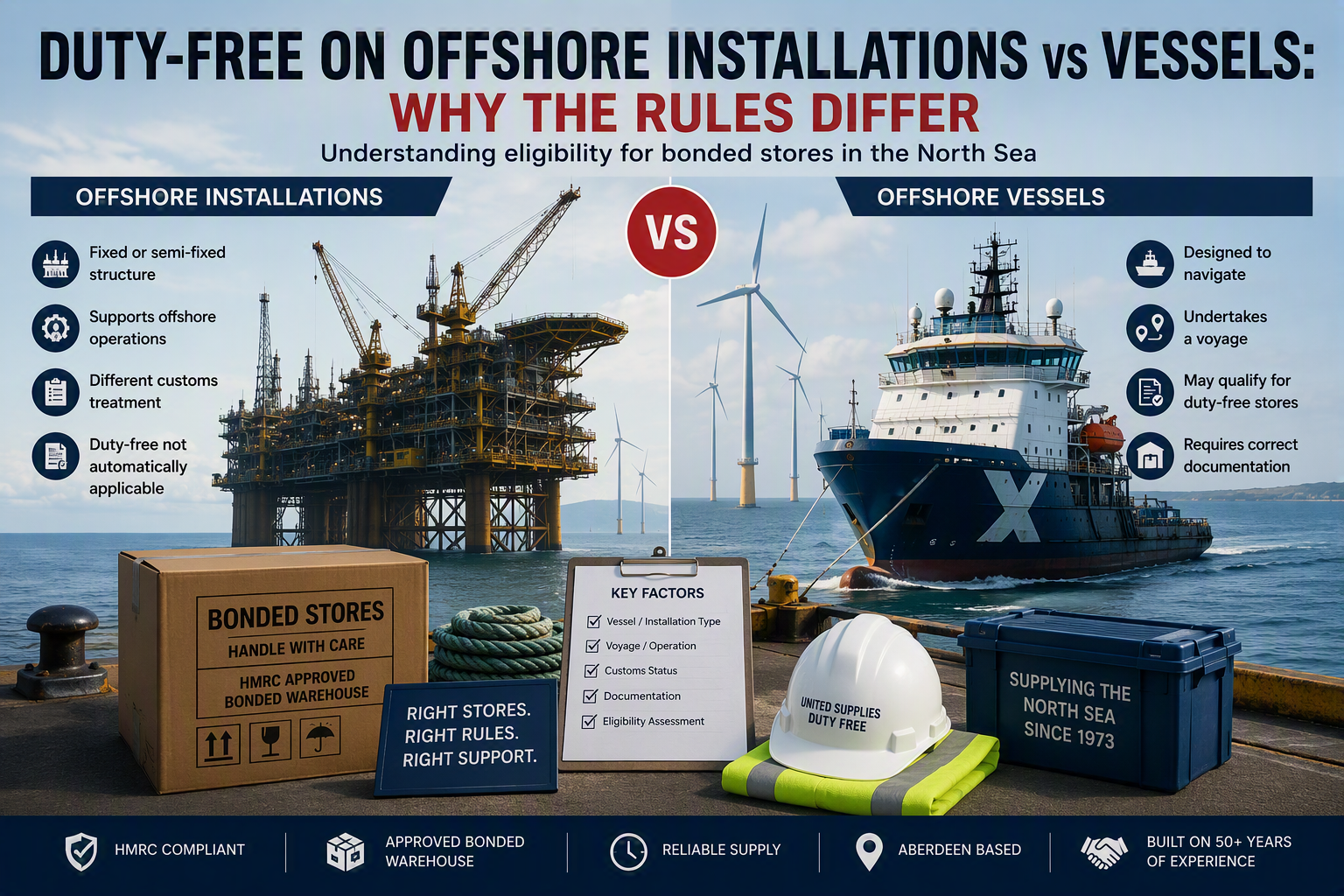
Why do duty-free rules differ between offshore installations and vessels? Learn how offshore installation duty free rules work, why vessel eligibility is different and the mistakes operators commonly make.
Can offshore installations receive duty-free stores in the same way as vessels?
Not necessarily. One of the most common misunderstandings in the North Sea is the assumption that the rules applying to offshore vessels also apply to offshore installations.
In practice, offshore installations and vessels are treated differently, and that difference can affect whether duty-free goods can be supplied.
For operators new to offshore logistics, the distinction can be confusing. After all, both may be located offshore, both may accommodate personnel for extended periods and both may require regular resupply.
From a customs perspective, however, they are not the same thing.
Why Do People Confuse Offshore Installations and Vessels?
The confusion is understandable.
A modern offshore installation can resemble a small floating community. Personnel work offshore for extended periods, supplies are transported from shore and logistics planning is a major part of daily operations.
Likewise, many offshore vessels support long-duration campaigns and maintain significant numbers of personnel on board.
To someone unfamiliar with customs procedures, the difference might appear largely administrative.
In reality, the distinction is fundamental.
What Is Considered an Offshore Installation?
In simple terms, an offshore installation is a fixed or semi-fixed structure used for offshore energy activities.
Examples include:
• Production platforms
• Drilling installations
• Offshore accommodation units
• Certain energy infrastructure assets
• Offshore processing facilities
These installations are designed to support offshore operations rather than undertake voyages.
That distinction becomes important when considering duty-free eligibility.
What Is Considered a Vessel?
A vessel is designed to navigate and operate at sea.
Examples include:
• Platform Supply Vessels (PSVs)
• Offshore Support Vessels (OSVs)
• Service Operation Vessels (SOVs)
• Survey vessels
• Construction support vessels
• Research vessels
• Crew Transfer Vessels (CTVs)
Vessels move between locations and undertake voyages as part of their operations.
This movement often forms part of the customs framework that governs bonded stores and duty-free supply.
Why Do The Rules Differ?
The short answer is that customs legislation historically evolved around vessels and voyages.
Duty-free stores are generally supplied through customs procedures linked to qualifying vessel operations. The vessel, its voyage and its operating circumstances form part of the eligibility assessment. An offshore installation operates under a different set of circumstances.
Although personnel may live and work offshore for extended periods, the installation itself is not undertaking a voyage in the way a vessel does.
As a result, the rules governing supply can be different.
Does Offshore Location Automatically Create Eligibility?
No.
This is probably the most common misconception we encounter. People often assume:
“It’s offshore, therefore it must qualify.“
Unfortunately, the process is not that simple.
The fact that a vessel or installation is located offshore does not automatically determine eligibility. Other factors need to be considered, including:
• The nature of the operation
• Customs requirements
• Applicable documentation
• The entity receiving the goods
This is one reason suppliers will often ask detailed questions before confirming whether duty-free stores can be supplied.
Why Does This Matter For Offshore Operators?
Because assumptions can lead to delays.
An operator may be familiar with bonded stores supplied to a vessel and assume the same approach will apply elsewhere.
Sometimes it does. Sometimes it does not. Understanding the distinction early helps avoid:
• Incorrect orders
• Documentation issues
• Delivery delays
• Last-minute changes to supply arrangements
For offshore campaigns operating to fixed schedules, those delays can become frustrating very quickly.
What About Accommodation Units?
Accommodation units often generate questions because they sit somewhere between traditional offshore installations and vessels.
They may be floating.
They may accommodate large numbers of personnel.
They may remain in one location for extended periods.
The specific circumstances matter.
As with many aspects of bonded stores supply, assumptions are rarely a substitute for reviewing the operational details.
What About Offshore Wind Projects?
As offshore wind grows throughout Scottish waters, similar questions are becoming increasingly common.
Operators ask whether:
• Service Operation Vessels qualify.
• Crew Transfer Vessels qualify.
• Offshore wind support vessels qualify.
• Offshore energy infrastructure should be treated differently.
The answer usually depends on the precise operation involved. This is one reason offshore wind has become such an active area of enquiry in recent years.
Many operators are highly experienced in construction, engineering or renewable energy but are navigating maritime customs procedures for the first time.
What Information Will Suppliers Usually Need?
Before discussing eligibility, suppliers will typically need information such as:
• Vessel or installation details
• Operational activity
• Voyage information, where applicable
• Delivery requirements
• Supporting documentation
The objective is straightforward:
To establish which customs procedures apply and what documentation is required.
Providing accurate information early usually leads to a much smoother process.
A Common Mistake We See
One issue appears repeatedly.
An offshore project has been planned in great detail:
The vessel schedule is confirmed.
Personnel movements are arranged.
Supplies have been organised.
Then someone discovers that assumptions have been made about duty-free eligibility.
At that point, there is often very little time available before mobilisation.
After decades supporting North Sea operations from Aberdeen, our advice remains remarkably consistent:
Discuss duty-free requirements at the start of the planning process, not the end.
A short conversation early on frequently prevents problems later.
Does This Difference Matter More As The Energy Sector Changes?
Probably.
Historically, much of the discussion around bonded stores focused on oil and gas vessels and installations.
Today, operators are also involved in:
• Offshore wind projects
• Carbon capture and storage developments
• Marine energy schemes
• Survey campaigns
• Construction projects
As the offshore sector diversifies, understanding how different assets are treated becomes increasingly important.
The answer for one vessel or installation may not necessarily apply to another.
So, Why Do The Rules Differ?
The simple answer is that offshore installations and vessels are not treated identically for customs purposes.
A vessel undertaking a voyage is not necessarily treated in the same way as an offshore installation supporting energy production or offshore operations.
That distinction affects how duty-free stores are assessed and supplied.
The safest approach is always to discuss your specific circumstances before planning deliveries rather than assuming the same rules apply across every offshore asset.
Final Thoughts
Duty-free supply in the North Sea is rarely just about the products involved. It is about ensuring the correct procedures are followed for the specific operation in question.
Understanding the difference between offshore installations and vessels is a good example of that principle in practice.
A little clarity at the start of the process can prevent a considerable amount of confusion later.
If you’re unsure whether a vessel, offshore installation or project may be eligible for duty-free stores, give our team a call and we’ll help you work through the requirements before mobilisation.
Related Reading:
- The Complete Guide to Duty-Free Supply in the North Sea (2027 Edition)
- Duty Free at Sea: A Plain-English Guide
- Can Offshore Wind Vessels Take Duty-Free Stores? What Operators Need to Know
- Which North Sea Vessels Qualify for Duty-Free Stores? An Eligibility Checklist
- How to Order Duty-Free Stores in Aberdeen: A Step-by-Step Guide
- Hydrogen, CCS and Marine Energy: The Next Duty-Free Frontier in the North Sea