

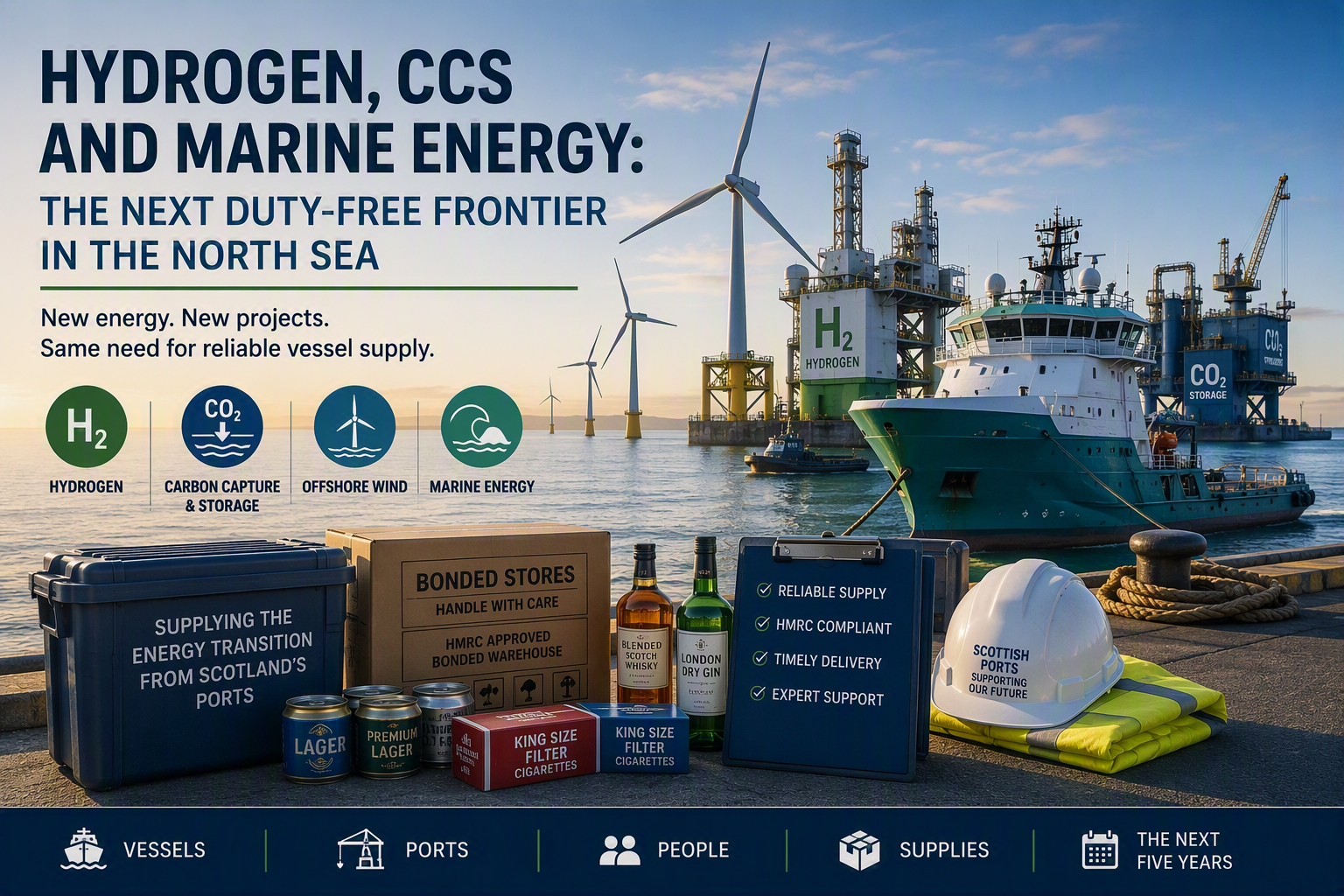
How will hydrogen, carbon capture and marine energy projects affect North Sea energy transition vessel supply? A practical guide to the vessels, ports, logistics and bonded stores requirements emerging across Scotland.
What does the North Sea energy transition mean for vessel supply?
In practical terms, it means more specialist vessels, more offshore campaigns, more activity around Scottish ports and a growing demand for experienced marine suppliers who understand how offshore projects actually operate. While oil and gas remains a major part of the North Sea economy, hydrogen, carbon capture and storage (CCS), and marine energy projects are creating entirely new vessel support requirements.
Much of the discussion around the energy transition focuses on policy, investment and emissions targets. From the quayside, the picture looks rather different. It looks like survey vessels preparing for a new offshore site. It looks like construction vessels mobilising specialist equipment. It looks like crews joining ships before a campaign begins. And it looks like suppliers making sure everything the vessel needs is on board before departure.
What Is Driving the North Sea Energy Transition?
The North Sea is becoming increasingly diverse.
Alongside established oil and gas activity, operators are investing in:
- Offshore wind
- Green hydrogen projects
- Carbon capture and storage (CCS)
- Wave energy developments
- Tidal energy schemes
- Low-carbon industrial infrastructure
Many of these initiatives are being developed around Scotland’s coastline and offshore waters.
For vessel operators, this means a growing range of projects requiring offshore support.
For suppliers, it means a growing range of customers with familiar logistical needs.
Why Does Hydrogen Create Demand for Vessel Supply Services?
Hydrogen projects tend to attract attention because of the production technology involved.
What receives less attention is the maritime activity surrounding development and operation.
Hydrogen infrastructure requires:
- Marine surveys
- Construction support
- Engineering inspections
- Personnel transfers
- Equipment mobilisation
Every one of those activities involves vessels.
Those vessels require:
- Provisions
- Consumables
- Bonded stores where eligible
- Logistics coordination
- Port support
In other words, hydrogen projects create much the same quayside activity that has supported other offshore energy sectors for decades.
What Is Carbon Capture and Storage (CCS)?
CCS involves capturing carbon dioxide emissions and transporting them to secure storage locations, often in geological formations beneath the seabed.
The North Sea is widely regarded as one of Europe’s most promising areas for large-scale carbon storage.
For maritime operators, CCS creates a variety of offshore requirements including:
- Survey work
- Construction activity
- Monitoring programmes
- Inspection campaigns
- Asset maintenance
Each stage generates vessel demand.
Each vessel movement generates support requirements.
What Types of Vessels Will Support CCS Projects?
A surprisingly familiar mix.
Many vessels involved in CCS will be similar to those already operating in offshore energy sectors.
Examples include:
Survey Vessels
Used to assess seabed conditions, monitor sites and collect environmental data.
Construction Support Vessels
Supporting installation and development phases.
Inspection Vessels
Providing access for engineers, technicians and project personnel.
Offshore Support Vessels
Transporting equipment, supplies and specialist teams.
Service Operation Vessels
Potentially supporting long-term maintenance activities as projects mature.
This is one reason many offshore service providers view CCS as a natural extension of existing North Sea expertise.
What About Wave and Tidal Energy?
Marine energy projects attract less publicity than offshore wind, but they continue to develop around Scotland.
Projects involving:
- Wave energy converters
- Tidal stream generators
- Demonstration arrays
- Research facilities
all require offshore support at various stages.
The number of vessels involved may be smaller than major wind projects, but the operational requirements are often similar.
A vessel supporting a tidal energy project still needs documentation, supplies, consumables and logistics planning.
The day-to-day realities of offshore operations remain remarkably consistent.
Which Scottish Ports Are Best Positioned?
Several ports are expected to play important roles as these industries develop.
These include:
- Aberdeen
- Peterhead
- Dundee
- Montrose
- Inverness
- Cromarty Firth facilities
- Leith
Each has different strengths.
Some are likely to support construction activity.
Others may become operations and maintenance hubs.
Some will specialise in project cargo.
Others will focus on long-term vessel support.
What links them all is growing relevance to the wider North Sea energy transition vessel supply market.
Will Traditional Offshore Skills Still Matter?
Very much so.
One misconception about the energy transition is that it represents a complete break from the past.
From a maritime perspective, many of the skills remain the same.
Operators still need people who understand:
- Vessel schedules
- Offshore logistics
- Marine documentation
- Port operations
- Weather delays
- Mobilisation planning
The technologies may change.
The practical realities of getting vessels offshore have not changed nearly as much.
How Will Vessel Mobilisations Change?
The biggest change is likely to be variety.
Historically, many suppliers worked with a relatively predictable mix of offshore support vessels serving oil and gas operators.
The transition introduces a broader customer base.
Suppliers increasingly encounter:
- Offshore wind developers
- Hydrogen projects
- CCS operators
- Research programmes
- Marine technology companies
Each sector has its own terminology and project objectives.
What they share is a reliance on vessels to deliver offshore work safely and efficiently.
Will Demand for Bonded Stores Continue?
Yes.
As offshore energy projects become more diverse, there will continue to be qualifying vessels requiring bonded stores and duty-free supplies.
The eligibility of any vessel depends on its specific operation and circumstances.
However, the overall need for reliable vessel support is unlikely to diminish.
Projects involving extended offshore campaigns often rely on experienced suppliers capable of delivering stores efficiently and in compliance with HMRC requirements.
The vessels may be supporting carbon storage rather than hydrocarbons, but they still require practical support before sailing.
What Is the Biggest Challenge Ahead?
From a supplier’s perspective, the challenge is not usually the product.
It is the planning.
After decades supporting North Sea operations from Aberdeen, one lesson appears repeatedly.
The projects that run most smoothly are rarely the ones with the largest budgets.
They are usually the ones where logistics planning begins early.
Whether the project involves oil and gas, offshore wind, hydrogen or CCS, the same pattern applies.
The vessel details need checked.
The documentation needs completed.
The delivery needs coordinated.
Leave those discussions until the evening before mobilisation and unnecessary problems tend to follow.
The technology may change, but human nature remains remarkably consistent.
What Will the Next Decade Look Like?
The North Sea is not becoming less important.
It is becoming more diverse.
Oil and gas operations will continue to occupy a significant role.
Alongside them, operators are developing:
- Offshore wind projects
- Hydrogen infrastructure
- CCS facilities
- Marine energy technologies
Every one of these developments requires vessels.
Every vessel requires support.
For marine suppliers, this creates an opportunity to apply decades of offshore experience to a broader range of projects than ever before.
The energy transition is often discussed as a technological transformation.
From the quayside, it looks more like an expansion of the offshore economy.
More projects.
More vessels.
More mobilisation activity.
More opportunity for companies that understand how offshore operations work in practice.
What Does This Mean for Vessel Operators?
The message is simple.
The next generation of North Sea energy projects will depend on the same fundamentals that have supported offshore operations for decades:
- Reliable logistics
- Practical planning
- Experienced suppliers
- Effective vessel support
The project names may change.
The technologies may evolve.
But vessels still need to sail with the right supplies, the right documentation and the right support behind them.
If you’re planning vessel operations connected to offshore wind, hydrogen, CCS or marine energy projects in Scottish waters, speak to our team before mobilisation and we’ll help you plan your vessel supply requirements.
Related Reading
- Supplying the ScotWind Build-Out: What the Next Five Years Look Like from the Quayside
- Can Offshore Wind Vessels Take Duty-Free Stores? What Operators Need to Know
- Duty Free at Sea: A Plain-English Guide to Bonded Stores for North Sea Vessels
- The Complete Guide to Duty-Free Supply in the North Sea (2027 Edition)