

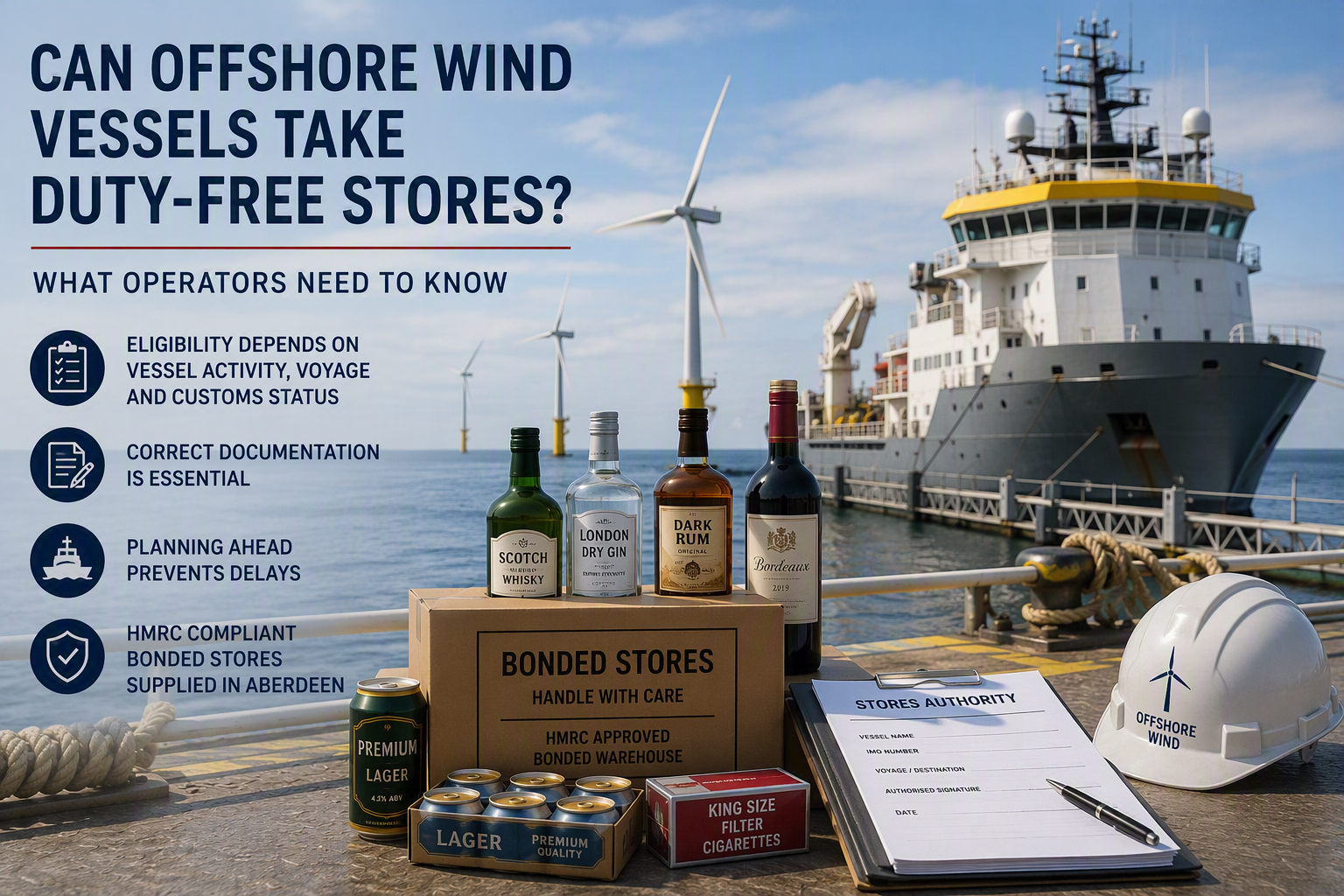
Learn how bonded stores for offshore wind vessels work, which vessels may qualify, what HMRC requires and common pitfalls to avoid.
Can offshore wind vessels take duty-free stores?
Sometimes, yes. Whether an offshore wind vessel can receive duty-free bonded stores depends on the vessel’s activity, operating area, customs status and the specific voyage involved. There is no single rule that applies to every service operation vessel, crew transfer vessel or offshore support ship.
That can be frustrating for operators because offshore wind often sits in a grey area between traditional shipping and offshore energy operations. A vessel working on a wind farm project in the North Sea may look very similar to a vessel supporting oil and gas operations, but the customs position can be entirely different.
The good news is that eligibility can usually be established quickly when the relevant information is available.
Why Is There Confusion Around Bonded Stores for Offshore Wind?
The offshore wind sector has grown rapidly over the last decade, while many customs procedures were originally developed around more traditional shipping and offshore oil and gas activity.
As a result, operators often ask:
- Can offshore wind vessels receive duty-free alcohol and tobacco?
- Are Service Operation Vessels (SOVs) treated differently from PSVs?
- Does working outside territorial waters change anything?
- What documentation is required?
- Does the destination matter?
The answer is usually: it depends on the operation, not simply the vessel type.
Two vessels that appear identical may have different eligibility depending on their specific voyage and working arrangements.
What Are Bonded Stores?
Before looking specifically at offshore wind, it helps to define the term.
Bonded stores are duty-free goods supplied under customs control to eligible vessels.
They commonly include:
- Cigarettes
- Tobacco products
- Spirits
- Beer
- Wine
These products are typically held within an HMRC-approved bonded warehouse before being supplied to qualifying vessels.
The goods remain under customs control until they are legally discharged through an approved process.
Which Types of Offshore Wind Vessels Might Require Bonded Stores?
The offshore wind sector uses a wide variety of vessel types.
These include:
Service Operation Vessels (SOVs)
Designed to support technicians working on offshore wind farms over extended periods.
SOVs often remain offshore for considerable durations and may require regular bonded stores deliveries depending on operational requirements.
Crew Transfer Vessels (CTVs)
Transport personnel between shore and offshore installations.
Because CTVs generally operate on short-duration trips, their circumstances are often different from larger offshore support vessels.
Construction Support Vessels
Used during installation and major project works.
These vessels may spend extended periods offshore and frequently operate internationally.
Survey Vessels
Used during site assessment, cable route surveys and environmental studies.
Operational profiles vary considerably from project to project.
Commissioning and Maintenance Vessels
Supporting turbine installation, inspection and maintenance throughout the asset lifecycle.
Each vessel type must be assessed according to the actual operation being undertaken.
Does Operating in the North Sea Automatically Qualify a Vessel?
No.
This is one of the most common misunderstandings.
Simply operating offshore does not automatically create entitlement to duty-free stores.
Operators sometimes assume that because a vessel is working at sea, bonded stores will automatically be available.
That is not always the case.
Eligibility depends on factors including:
- Voyage details
- Operational purpose
- Customs status
- Offshore location
- Destination
- Applicable HMRC requirements
The assessment should be made before stores are ordered rather than immediately before departure.
What Information Will a Supplier Need?
When assessing a request for bonded stores offshore wind operators should expect to provide details such as:
- Vessel name
- IMO number
- Operator details
- Nature of operation
- Offshore location
- Voyage information
- Stores authority documentation
- Required quantities
The objective is straightforward.
The supplier must be able to demonstrate why duty-free treatment is appropriate for the specific vessel and voyage.
Without sufficient supporting information, stores cannot normally be released.
What Is a Stores Authority?
A stores authority is one of the most important pieces of documentation in the supply process.
It authorises the supply of bonded stores to the vessel and forms part of the audit trail required under HMRC procedures.
Depending on the circumstances, it may be signed by:
- The master
- Vessel operator
- Authorised representative
- Vessel agent acting on behalf of the vessel
Errors in stores authority documentation remain one of the most common causes of last-minute delays.
How Does the Process Work in Aberdeen?
For many offshore wind projects, Aberdeen serves as a mobilisation point for vessels operating throughout the North Sea.
A typical process may involve:
- Eligibility review.
- Documentation check.
- Confirmation of quantities.
- Preparation of bonded stores.
- Delivery to vessel.
- Completion of customs records.
While the process appears straightforward, accuracy matters.
A missing signature or incorrect vessel information can sometimes delay supplies at exactly the moment operators want to be preparing for departure.
What Is Different About Offshore Wind Compared With Oil and Gas?
From a stores perspective, the main difference is often operational rather than physical.
An offshore support vessel serving an oil and gas installation may be undertaking a different type of voyage from a vessel servicing a wind farm, even if the vessels themselves are similar.
That distinction can affect how customs requirements apply.
This is why experienced suppliers normally review the operational circumstances rather than relying solely on vessel type.
Over the last few years, we have seen an increasing number of enquiries from offshore wind operators who initially assumed existing oil and gas practices would automatically apply to wind projects.
Sometimes they do.
Sometimes they do not.
The details matter.
What Mistakes Do Offshore Wind Operators Most Commonly Make?
One recurring issue stands out.
Operators often focus on the physical stores and not the paperwork.
The vessel schedule is agreed.
The technicians are booked.
The mobilisation plan is complete.
Then someone asks about bonded stores two hours before sailing.
After decades supplying North Sea vessels, the simplest advice remains the most valuable:
Have the eligibility discussion early.
If a vessel qualifies, the process is usually straightforward.
If clarification is required, there is time to resolve it without creating pressure on a mobilisation schedule.
The operators who experience the fewest issues are generally the ones who address stores requirements during voyage planning rather than immediately before departure.
Are Bonded Stores Becoming More Important as Offshore Wind Grows?
In many areas, yes.
The scale of offshore wind activity in the North Sea continues to increase.
Projects are moving further offshore.
Campaigns are becoming longer.
Support vessels are spending more time at sea.
Service Operation Vessels in particular have become increasingly important as wind farms move further from shore.
As activity grows, demand for clear guidance on bonded stores offshore wind operations is increasing as well.
Many operators entering the sector come from engineering, construction or renewable energy backgrounds rather than traditional shipping, so questions about customs and stores procedures are entirely understandable.
Where Can Operators Find Official Guidance?
Operators should always refer to current HMRC and GOV.UK guidance for the latest official requirements.
Useful starting points include:
- HMRC Customs Warehousing Guidance: https://www.gov.uk/guidance/customs-warehouses
- HM Revenue & Customs: https://www.gov.uk/government/organisations/hm-revenue-customs
Requirements can change, and individual circumstances should always be assessed on their own merits.
So, Can Offshore Wind Vessels Take Duty-Free Stores?
Sometimes they can, but there is no automatic entitlement.
The key factors are the vessel’s operation, voyage and customs position rather than the fact that it works in offshore wind.
For operators, the safest approach is to establish eligibility early, ensure documentation is completed correctly and work with a supplier familiar with North Sea offshore operations.
That avoids delays, prevents last-minute complications and helps ensure vessels sail with the stores they require.
If you’re planning an upcoming SOV rotation, maintenance campaign or offshore wind mobilisation from Aberdeen, speak to our team before sailing and we’ll help you work through the bonded stores requirements.