

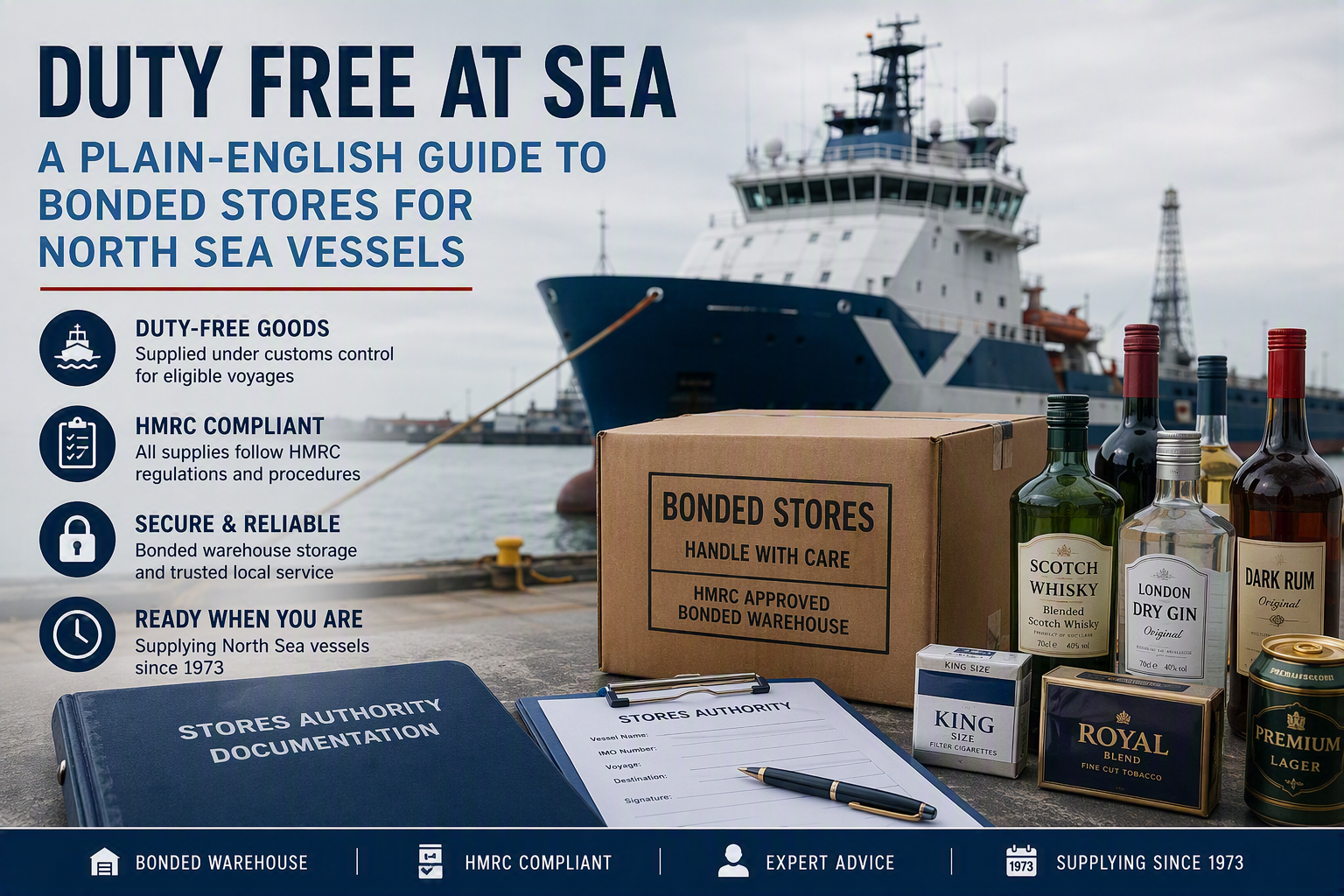
What are bonded stores? This plain-English guide explains bonded stores for North Sea vessels, including duty-free goods, documentation requirements, HMRC rules and common mistakes.
In simple terms, bonded stores are duty-free goods supplied to eligible vessels for use or consumption during a voyage. They typically include products such as tobacco, alcohol and certain consumable stores that are exempt from UK duty because they are being supplied under customs control for qualifying voyages.
If you are new to vessel operations, offshore logistics or procurement, the terminology can sound more complicated than it needs to be. This guide explains bonded stores in plain English and answers the questions most commonly asked by masters, pursers, vessel agents and operators working in the North Sea.
What Are Bonded Stores?
Bonded stores are goods held under customs control in a bonded warehouse before being supplied to an eligible vessel without UK duty being paid.
Typical bonded stores include:
- Spirits
- Beer and wine
- Cigarettes and other tobacco products
- Certain ship’s consumable stores
The key point is that these goods remain under customs control until they are legally supplied to a qualifying vessel.
This is why bonded stores cannot simply be sold or distributed in the same way as ordinary retail goods.
Why Are They Called “Bonded” Stores?
The term comes from the bonded warehouse system.
A bonded warehouse is a secure facility approved by HMRC where goods can be stored without duty being paid immediately.
Duty only becomes payable when goods enter the UK domestic market. If the goods are supplied under an approved customs procedure to a qualifying vessel, that duty liability may never arise.
United Supplies has operated bonded warehouse facilities in Aberdeen for decades and remains the only multi-user Customs and Excise bonded warehouse in Aberdeen.
That local presence matters when vessels require stores at short notice.
Which North Sea Vessels Can Receive Bonded Stores?
This is probably the most common question we receive.
The answer is: not every vessel qualifies.
Eligibility depends on factors including:
- Vessel type
- Voyage pattern
- Customs status
- Destination
- Operational activity
Examples of vessels that may qualify under the appropriate circumstances include:
- Offshore supply vessels (OSVs)
- Platform supply vessels (PSVs)
- Construction support vessels
- Survey vessels
- Research vessels
- Accommodation vessels
- Certain offshore wind support vessels
- Vessels engaged in international voyages
The exact circumstances matter, which is why documentation should always be checked before stores are supplied.
A vessel working entirely within UK territorial limits may be treated differently from a vessel operating internationally or servicing offshore installations.
What Types of Goods Are Usually Supplied as Bonded Stores?
The most common requests involve:
Tobacco Products
Including:
- Cigarettes
- Hand-rolling tobacco
- Cigars
Alcohol
Including:
- Whisky
- Vodka
- Gin
- Rum
- Wine
- Beer
Other Consumable Stores
Depending on the vessel and operational requirements, certain other stores may also be supplied through bonded arrangements.
The availability of products and eligibility rules should always be confirmed before delivery.
Who Controls the Supply of Bonded Stores?
Bonded stores are heavily regulated.
Supplies operate within a framework governed by HMRC customs requirements and documented procedures.
Relevant guidance is available through HMRC and GOV.UK, including customs warehousing guidance and notices relating to excise goods and ships’ stores.
External Reference:
- HMRC Customs Warehousing Guidance: https://www.gov.uk/guidance/customs-warehouses
- GOV.UK Customs and Excise Guidance: https://www.gov.uk/government/organisations/hm-revenue-customs
The paperwork is not simply administrative. It creates the audit trail that allows duty-free goods to move legally through the supply chain.
What Documentation Is Required?
Requirements vary according to vessel type and voyage.
Typically, suppliers may need information such as:
- Vessel name
- IMO number
- Voyage details
- Destination information
- Stores authority documentation
- Master or authorised signatory details
- Quantity requested
The guiding principle is straightforward:
HMRC expects suppliers to be able to demonstrate why duty-free treatment was appropriate.
Without adequate documentation, stores generally cannot be released.
Who Signs the Stores Authority?
This depends on the vessel and operating arrangements.
In practice, the stores authority is often signed by:
- The master
- The vessel operator
- An authorised representative
- A vessel agent acting under authority
The important point is that the individual signing must be authorised to do so.
One of the most common causes of delay is discovering that documentation has been prepared correctly but signed by someone who does not actually have authority to approve the supply.
How Are Bonded Stores Delivered?
For Aberdeen operators, bonded stores are often supplied directly to the quayside before sailing.
Timing can be critical.
A vessel may have only a narrow mobilisation window before departure, particularly during busy periods in the North Sea energy sector.
Deliveries are typically coordinated with:
- Port agents
- Vessel operators
- Masters
- Offshore logistics teams
The objective is always to ensure stores arrive in time for departure while maintaining complete customs compliance.
What Is the Difference Between Ship’s Stores and Bonded Stores?
The terms are often used interchangeably, but they are not always identical.
Ship’s stores can refer broadly to goods intended for use aboard a vessel.
Bonded stores refer specifically to goods supplied under customs control, usually with duty relief or excise treatment attached.
In everyday conversation, many operators use the phrases interchangeably, but from a customs perspective the distinction can matter.
What Mistakes Cause the Most Delays?
After more than five decades supplying vessels in Aberdeen, one issue appears more often than almost any other.
The vessel qualifies.
The products are available.
The delivery slot is booked.
But somebody leaves the paperwork until the last minute.
Bonded stores are one of those things that seem straightforward when everything is in place and suddenly become complicated when documentation is incomplete an hour before sailing.
The safest approach is to confirm:
- Eligibility
- Documentation
- Quantities
- Delivery arrangements
as early as possible.
That simple step avoids a surprising number of problems.
Why Does Aberdeen Remain Important for Bonded Stores?
Aberdeen continues to play a central role in offshore operations across the North Sea.
The region supports:
- Oil and gas operations
- Offshore wind projects
- Survey activity
- Construction campaigns
- Marine support services
Many vessels operating from Aberdeen require dependable access to bonded stores alongside other marine supplies.
A local bonded warehouse allows stores to be supplied efficiently and in compliance with HMRC requirements without the delays that can come from sourcing products further afield.
Do Bonded Stores Still Matter Today?
Absolutely.
The vessels have changed.
The offshore sector has evolved.
New industries such as offshore wind have become increasingly important.
But the practical requirement remains the same.
Qualifying vessels still need access to duty-free supplies, and operators still need those supplies delivered correctly, legally and on time.
Bonded stores remain an everyday part of maritime operations throughout the North Sea.
Where Can You Get Advice on Bonded Stores in Aberdeen?
If you’re unsure whether a vessel qualifies, what documentation is required or how bonded stores can be supplied for an upcoming sailing, it is worth discussing the details before a delivery is arranged.
United Supplies has been supplying North Sea vessels from Aberdeen since 1973 and operates Aberdeen’s only multi-user Customs and Excise bonded warehouse.
If you’re planning a vessel mobilisation and need advice on bonded stores, give our team a call and we’ll talk through the requirements before sailing.
Related Reading:
- The Complete Guide to Duty-Free Supply in the North Sea (2027 Edition)
- Can Offshore Wind Vessels Take Duty-Free Stores? What Operators Need to Know
- Hydrogen, CCS and Marine Energy: The Next Duty-Free Frontier in the North Sea
- Supplying the ScotWind Build-Out: What the Next Five Years Look Like from the Quayside