

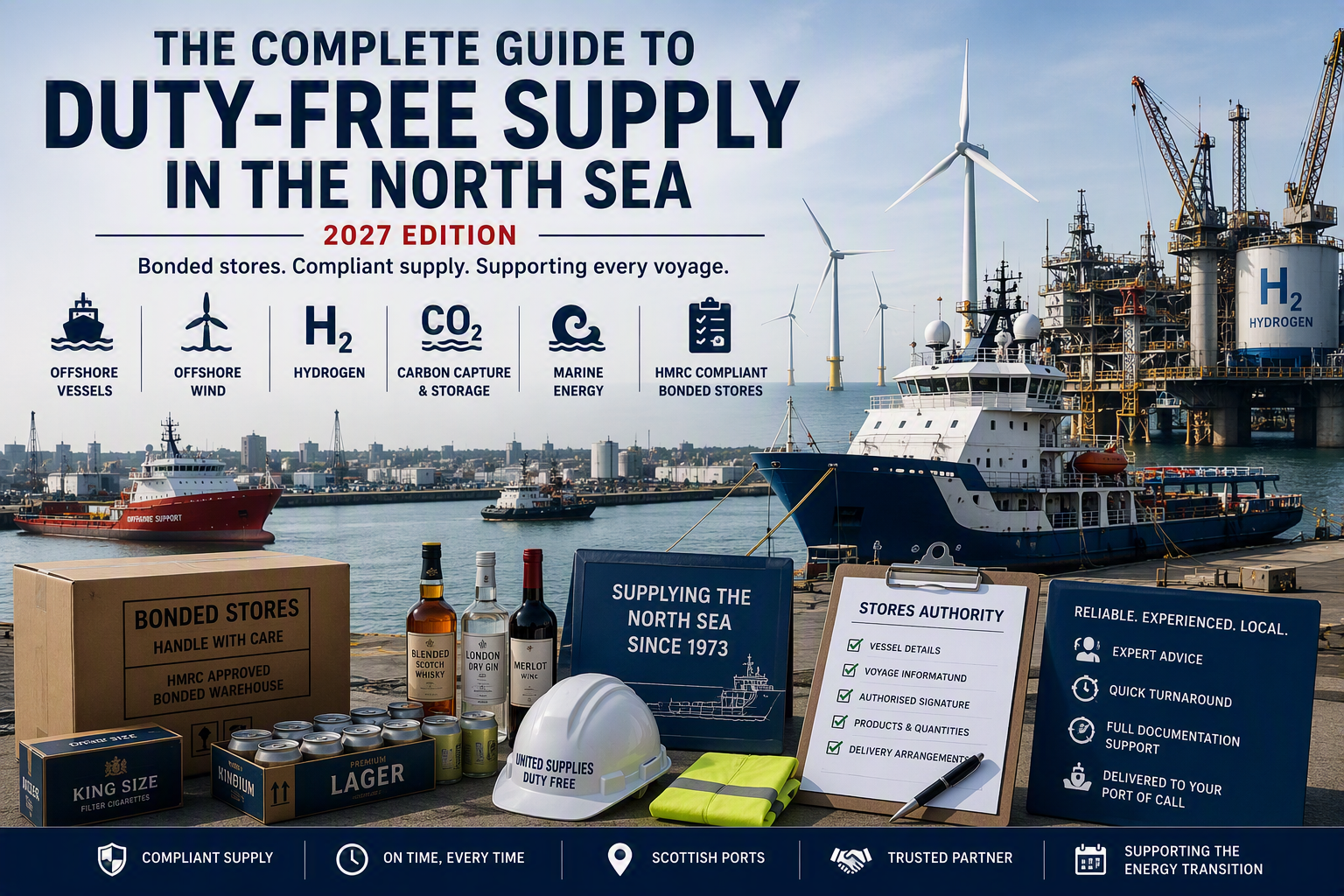
The complete North Sea duty free supply guide for 2027. Learn how bonded stores work, which vessels qualify, required documentation, HMRC considerations and common operational mistakes.
How does duty-free supply work in the North Sea?
In simple terms, qualifying vessels can receive certain goods, including alcohol and tobacco products, without UK duty being paid, provided the supply is made under the correct customs procedures and supported by the appropriate documentation. The exact requirements depend on the vessel, voyage and operational circumstances.
For many people entering the offshore sector, duty-free supply appears complicated. There are stores authorities, bonded warehouses, customs requirements and vessel eligibility rules to navigate.
In reality, the fundamentals are fairly straightforward once you understand how the system works.
This guide explains the process in plain English and provides a practical overview of North Sea duty free supply as it operates today.
What Is Duty-Free Supply?
Duty-free supply refers to the provision of qualifying goods to eligible vessels under customs procedures that allow those goods to be supplied without UK duty being paid.
Most commonly, these goods include:
- Cigarettes
- Tobacco products
- Spirits
- Wine
- Beer
These products are generally stored in an HMRC-approved bonded warehouse until they are legally supplied to an eligible vessel.
The system exists to support maritime operations while maintaining customs control over excise goods.
What Are Bonded Stores?
The terms “duty-free stores” and “bonded stores” are often used interchangeably.
Strictly speaking, bonded stores are goods held within a bonded warehouse under customs control before being supplied to a qualifying vessel.
The warehouse forms a key part of the process.
Until the goods are legally removed through the appropriate procedures, they remain under customs control.
This is why documentation is so important.
A supplier must be able to demonstrate exactly how and why the goods were supplied.
Why Does the North Sea Still Use Bonded Stores?
The answer is simple.
The North Sea remains one of the world’s busiest offshore operating regions.
Every day, vessels support:
- Oil and gas operations
- Offshore wind projects
- Survey campaigns
- Construction activities
- Inspection programmes
- Research projects
- Decommissioning work
Many of these vessels spend extended periods offshore and require regular support.
Duty-free supply remains part of that support infrastructure.
Which Vessels Can Receive Duty-Free Stores?
This is probably the most common question operators ask.
Unfortunately, there is no universal answer.
Eligibility depends on factors including:
- Vessel type
- Voyage details
- Operational activity
- Customs status
- Offshore location
Examples of vessels that may qualify under the appropriate circumstances include:
- Platform Supply Vessels (PSVs)
- Offshore Support Vessels (OSVs)
- Construction Support Vessels
- Survey Vessels
- Research Vessels
- Accommodation Vessels
- Service Operation Vessels (SOVs)
- Certain internationally trading vessels
The important point is that eligibility is assessed according to the specific operation rather than simply the vessel’s name or class.
Can Offshore Wind Vessels Receive Duty-Free Stores?
Sometimes.
As offshore wind grows across Scottish waters, this has become an increasingly common question.
The answer depends on:
- The nature of the operation
- The voyage being undertaken
- The vessel’s customs position
- Supporting documentation
Two vessels working on the same wind farm project may not necessarily have identical eligibility.
That is why experienced suppliers assess each case individually.
What Documents Are Required?
Documentation forms the backbone of the entire system.
While requirements vary, suppliers will typically need information such as:
- Vessel name
- IMO number
- Voyage details
- Operator information
- Stores authority
- Quantity requests
- Delivery details
The purpose is not bureaucracy for its own sake.
The paperwork creates the audit trail necessary to show why duty-free treatment was appropriate.
Without appropriate documentation, stores generally cannot be released.
What Is a Stores Authority?
A stores authority is a document authorising the supply of bonded stores to a vessel.
It forms part of the customs record supporting the movement of duty-free goods.
Depending on circumstances, it may be signed by:
- The master
- A vessel operator
- An authorised representative
- A vessel agent acting with authority
One incorrectly completed stores authority can delay an otherwise straightforward delivery.
Who Supplies Duty-Free Stores?
Supplies are typically made through approved bonded warehouse operators with experience of maritime logistics and customs procedures.
A good supplier does considerably more than provide products.
They also help ensure:
- Documentation is complete
- Eligibility has been assessed
- Customs requirements are satisfied
- Deliveries arrive when needed
This practical support often becomes most valuable when mobilisation schedules are tight.
How Does Delivery Work?
The process typically follows a sequence like this:
Step 1: Confirm Eligibility
The vessel’s operation is reviewed.
Step 2: Check Documentation
Required paperwork is completed and verified.
Step 3: Prepare Stores
Products are selected and prepared for dispatch.
Step 4: Coordinate Delivery
Delivery is arranged with:
- Port agents
- Vessel operators
- Masters
- Logistics teams
Step 5: Complete Customs Records
Documentation is finalised to maintain compliance.
When planned properly, the process is usually straightforward.
Which Ports Are Most Active?
The North Sea duty-free supply market is closely linked to major offshore ports.
Key locations include:
- Aberdeen
- Peterhead
- Montrose
- Dundee
- Inverness and Cromarty Firth facilities
- Great Yarmouth
- Hull
- Lowestoft
The exact pattern changes depending on offshore activity levels, project locations and vessel deployment.
For offshore energy operations, Aberdeen continues to play a particularly important role.
How Has Offshore Wind Changed the Market?
A decade ago, conversations around bonded stores were dominated by oil and gas activity.
Today, offshore wind has become a major part of the picture.
Vessels supporting:
- ScotWind developments
- Operations and maintenance campaigns
- Survey work
- Construction programmes
are increasingly common throughout Scottish waters.
This has widened the range of operators seeking guidance on duty-free supply procedures.
What About Hydrogen and Carbon Capture Projects?
The next phase of North Sea development is already emerging.
Projects involving:
- Green hydrogen
- Carbon capture and storage (CCS)
- Marine energy technologies
all require offshore support.
While the technologies may be new, the operational reality often looks familiar.
Vessels still need:
- Mobilisation support
- Consumables
- Logistics coordination
- Duty-free supplies where eligible
From a supplier’s perspective, the fundamentals remain remarkably consistent.
What Are the Most Common Mistakes?
After more than fifty years serving North Sea vessels from Aberdeen, one issue appears repeatedly.
Documentation is left until the last minute.
The vessel is booked.
The crew is organised.
The offshore campaign is ready.
Then somebody starts looking for the stores authority a few hours before departure.
The projects that run most smoothly tend to be the ones where stores planning happens early.
It sounds obvious, but it is probably the single most valuable lesson in duty-free supply.
Why Does Experience Matter?
Duty-free supply operates at the intersection of logistics, customs compliance and offshore operations.
A supplier needs to understand:
- Vessel schedules
- Offshore energy projects
- Port procedures
- Documentation requirements
- Delivery logistics
Most issues are not caused by complicated customs questions.
They are caused by simple operational problems occurring at inconvenient moments.
Experience helps prevent those situations before they develop.
What Does the Future Look Like?
The North Sea is changing.
Oil and gas remains important.
Offshore wind continues to expand.
Hydrogen and CCS projects are developing.
Marine energy technologies are advancing.
What connects all of these sectors is a continuing dependence on vessels and the support networks that keep those vessels operating.
That means duty-free supply remains an important part of the offshore logistics chain.
The products may not change dramatically.
The vessel mix certainly will.
Frequently Asked Questions
What are bonded stores?
Bonded stores are duty-free goods held under customs control before being supplied to qualifying vessels.
Can every vessel receive duty-free stores?
No. Eligibility depends on the vessel, voyage and operational circumstances.
What is a bonded warehouse?
A bonded warehouse is an HMRC-approved facility where goods can be held under customs control before lawful release.
Do offshore wind vessels qualify?
Some do, but eligibility depends on the specific operation and supporting documentation.
What causes the most delays?
Missing or incomplete documentation remains one of the most common causes of delay.
The Complete North Sea Duty Free Supply Guide: Final Thoughts
While duty-free supply can initially appear complex, the principles are straightforward:
- Establish eligibility.
- Complete the paperwork correctly.
- Work with an experienced supplier.
- Plan ahead.
Those four steps resolve the vast majority of issues before they become problems.
If you’re planning an offshore campaign, vessel mobilisation or project support operation in the North Sea, speak with our team before sailing and we’ll help you work through the duty-free supply requirements for your vessel.
Related Reading:
- Duty Free at Sea: A Plain-English Guide to Bonded Stores for North Sea Vessels
- Can Offshore Wind Vessels Take Duty-Free Stores? What Operators Need to Know
- Supplying the ScotWind Build-Out: What the Next Five Years Look Like from the Quayside
- Hydrogen, CCS and Marine Energy: The Next Duty-Free Frontier in the North Sea