

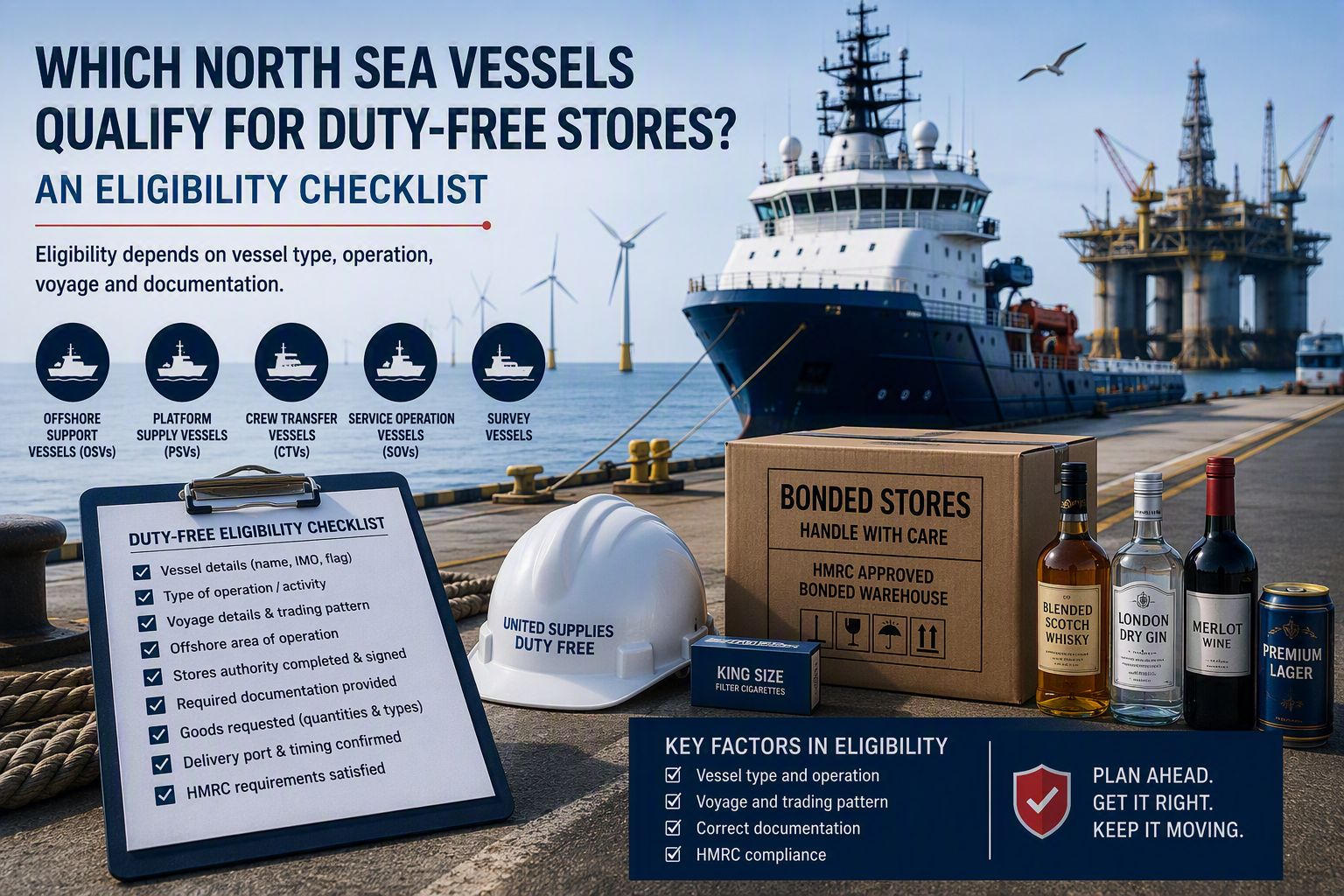
Which vessels qualify for duty-free stores in the UK? This practical eligibility checklist explains duty free eligibility for vessels, common misconceptions and the information suppliers need before release.
Which vessels qualify for duty-free stores in the UK?
The short answer is that some do and some do not. Eligibility depends on the vessel’s operation, voyage, customs status and supporting documentation. There is no simple list of vessel names that automatically qualify, which is why eligibility should always be confirmed before stores are ordered.
This is one of the most common questions vessel operators, agents and masters ask. It is also one of the areas where misunderstandings can create last-minute delays.
The good news is that most eligibility questions can be resolved quickly once the relevant details are available.
Why Is Vessel Eligibility So Important?
Duty-free stores are supplied under customs procedures that allow certain goods to be provided without UK duty being paid.
Typical products include:
- Cigarettes
- Tobacco products
- Spirits
- Beer
- Wine
Because these goods are supplied under customs control, suppliers need to be satisfied that the vessel and voyage meet the relevant requirements.
A vessel’s name alone is rarely enough to establish eligibility.
Does Vessel Type Determine Eligibility?
Not always.
This is one of the biggest misconceptions in the offshore sector.
Many operators assume that:
“It’s an offshore vessel, so it must qualify.”
That is not necessarily true.
A vessel’s activity often matters more than its classification.
Two identical vessels may have different eligibility depending on what they are doing and where they are operating.
Which North Sea Vessels Commonly Request Duty-Free Stores?
The following vessel types frequently make enquiries regarding bonded stores and duty-free supplies:
Platform Supply Vessels (PSVs)
PSVs remain among the most common vessel types operating throughout the North Sea.
Depending on the voyage and operational circumstances, they may be eligible for duty-free stores.
Offshore Support Vessels (OSVs)
OSVs undertake a wide range of activities and are regularly involved in offshore energy projects.
Eligibility should be assessed according to the specific operation.
Construction Support Vessels
Commonly used during installation and infrastructure projects.
Their qualification depends on the nature of the work being undertaken and the relevant voyage details.
Survey Vessels
Survey campaigns generate a considerable amount of vessel activity throughout UK waters.
Many survey vessels request guidance on bonded stores eligibility before deployment.
Research Vessels
Research and scientific operations can involve complex operating patterns, making individual assessment particularly important.
Accommodation Vessels
Long-duration offshore operations often make accommodation vessels regular users of stores supply services.
Service Operation Vessels (SOVs)
SOVs supporting offshore wind projects are becoming increasingly common throughout Scottish waters.
Whether duty-free stores can be supplied depends on the specific operational circumstances involved.
Do Offshore Wind Vessels Automatically Qualify?
No.
As offshore wind grows across the North Sea, this question is becoming increasingly common.
Many people assume that because a vessel operates offshore, it automatically qualifies.
That is not how the process works.
The supplier will normally need to understand:
- The operation being undertaken
- The voyage involved
- Supporting documentation
- Relevant customs information
Each vessel should be assessed individually.
Does Location Alone Determine Eligibility?
Again, no.
Operating in the North Sea does not automatically create entitlement to duty-free stores.
Likewise, simply being offshore is not enough.
Eligibility depends on a combination of factors rather than a single criterion.
This is one reason experienced suppliers tend to ask several questions before confirming whether stores can be released.
What Information Will A Supplier Usually Request?
Before supplying duty-free stores, expect questions such as:
What Is the Vessel Name?
The basic starting point for any assessment.
What Is the IMO Number?
This helps identify the vessel correctly.
What Operation Is Being Undertaken?
A survey campaign is different from a maintenance campaign.
Construction work is different from offshore accommodation.
The operational context matters.
Where Is the Vessel Operating?
Location forms part of the overall assessment.
What Are the Voyage Details?
Voyage information is often required to support eligibility decisions.
Has the Stores Authority Been Completed?
Documentation is typically required before stores can be released.
What Is a Stores Authority?
A stores authority is a document authorising the supply of bonded stores.
It forms part of the customs record supporting the transaction.
Depending on the circumstances, it may be signed by:
- The master
- Vessel operator
- Authorised representative
- Vessel agent
One missing signature can delay an otherwise straightforward supply.
An Eligibility Checklist for Vessel Operators:
Before requesting duty-free stores, it is worth checking the following:
✅ Vessel Details Available
- Vessel name confirmed
- IMO number available
- Operator details available
✅ Voyage Information Confirmed
- Relevant voyage details prepared
- Operational information available
✅ Documentation Ready
- Stores authority completed
- Required signatures obtained
✅ Delivery Requirements Confirmed
- Delivery location agreed
- Timing agreed
- Quantities confirmed
✅ Eligibility Discussed Early
- Supplier contacted before mobilisation
- Questions resolved before sailing
Operators who work through these points early typically experience the fewest delays.
What Causes Most Eligibility Problems?
Surprisingly, it is not usually customs complexity.
After decades supplying offshore vessels from Aberdeen, the most common issue is timing.
Eligibility is often discussed too late.
A vessel mobilisation may have been planned for weeks.
The client briefing is complete.
The crew is ready.
Departure is approaching.
Then someone asks whether the vessel qualifies for duty-free stores.
At that point there may be very little time available to resolve documentation questions.
The most effective approach is also the simplest:
Raise the eligibility question early.
Doing so gives everyone time to confirm requirements and avoid unnecessary pressure before sailing.
Does Vessel Eligibility Change Over Time?
It can.
A vessel may undertake different types of work during different projects.
The same vessel could be involved in:
- Offshore wind support
- Survey operations
- Energy infrastructure work
- Construction campaigns
The operational context may change from one assignment to the next.
That is why suppliers generally focus on the specific voyage rather than relying on historical assumptions.
Who Should Operators Speak To?
If there is uncertainty about eligibility, it is far better to ask before arrangements are finalised.
An experienced bonded stores supplier can usually identify what information is required and guide operators through the process.
Most eligibility questions are straightforward once the correct details are available.
Final Thoughts:
There is no universal list of vessels that automatically qualify for duty-free stores in the UK.
Eligibility depends on the vessel’s operation, voyage and supporting documentation.
The safest approach is to treat every mobilisation as its own assessment, confirm requirements early and ensure documentation is completed in good time.
That avoids delays and helps ensure stores can be supplied when required.
If you’re planning a North Sea mobilisation and want to confirm whether your vessel may qualify for duty-free stores, speak to our team before sailing and we’ll help you work through the requirements.