

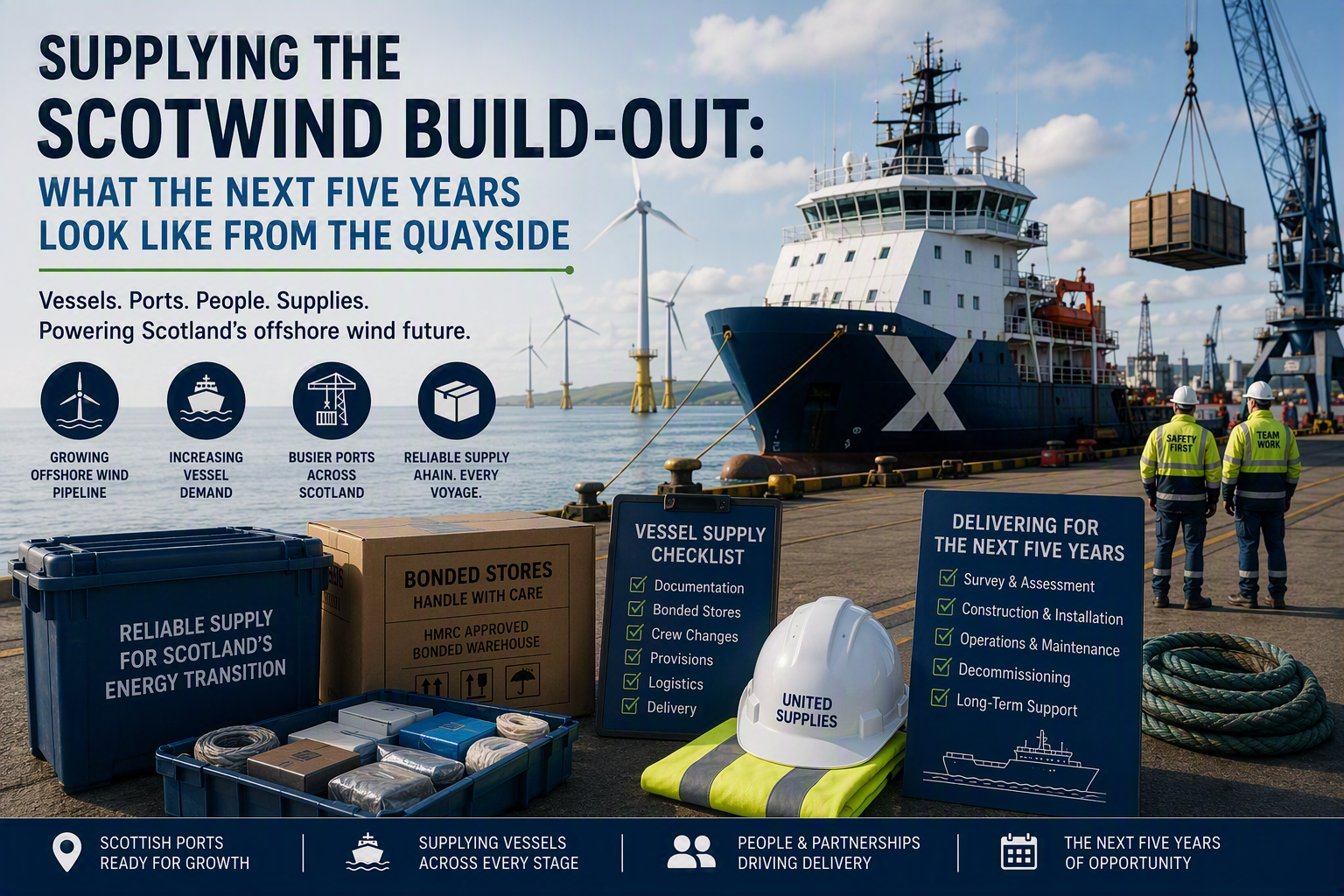
How will ScotWind affect Scotland’s maritime supply chain? A practical look at offshore wind vessel supply in Scotland, vessel demand, port activity, bonded stores and what operators can expect over the next five years.
What does the ScotWind programme mean for the offshore wind vessel supply chain in Scotland?
In simple terms, it means more vessels, more port calls, more offshore personnel, more logistics movements and significantly greater demand for reliable marine suppliers. For companies supplying vessels from ports such as Aberdeen, Peterhead, Montrose, Dundee and Inverness, ScotWind is not a future opportunity. It is already changing the conversations taking place on the quayside.
Much of the public discussion around ScotWind focuses on turbines, investment figures and renewable energy targets. Those are important. But every offshore development ultimately depends on vessels, crews, ports, consumables, stores and logistics. That practical side of the industry is where projects either run smoothly or encounter delay.
What Is ScotWind?
ScotWind is the Crown Estate Scotland leasing programme designed to support the development of new offshore wind projects in Scottish waters.
The programme has attracted significant investment from developers planning large-scale fixed and floating offshore wind projects around Scotland’s coastline.
For the maritime sector, the importance of ScotWind is straightforward:
Every offshore project creates vessel traffic.
Those vessels require support.
That support creates work throughout the offshore wind supply chain.
Why Does ScotWind Matter to Vessel Suppliers?
When people hear “offshore wind”, they often picture installation vessels and turbine towers.
In reality, a wind farm creates demand for a wide range of maritime support services throughout its life.
The vessel requirements begin long before construction.
Projects typically require:
- Survey vessels
- Environmental monitoring vessels
- Geotechnical vessels
- Crew transfer vessels (CTVs)
- Service operation vessels (SOVs)
- Construction support vessels
- Cable installation vessels
- Accommodation vessels
- Guard vessels
- Heavy lift vessels
Each category generates demand for marine logistics and vessel supply services.
What Will Happen During the Development Phase?
Before a turbine is ever installed, developers need enormous amounts of information.
Survey campaigns often begin years in advance.
Vessels may be involved in:
- Seabed surveys
- Environmental assessments
- Geophysical surveys
- Geotechnical investigations
- Route assessments
The public tends not to notice this stage because there are no visible turbines yet.
From a quayside perspective, however, activity increases significantly.
Survey vessels still require:
- Stores
- Consumables
- Logistics support
- Crew changes
- Port services
In many ways, this is the first indicator that a major offshore project is gathering momentum.
Which Vessels Will Become More Common?
Service Operation Vessels (SOVs)
Few vessel types are likely to become as familiar around Scottish ports as SOVs.
These vessels act as offshore bases for technicians working on wind farms.
Unlike many traditional offshore support vessels, SOVs can remain operational offshore for extended periods while supporting maintenance campaigns.
As ScotWind projects move further offshore, SOVs become increasingly important.
Crew Transfer Vessels (CTVs)
CTVs move technicians between shore and offshore assets.
While smaller than SOVs, they form a critical part of wind farm logistics and are likely to remain a common sight throughout Scotland.
Construction Support Vessels
During major build phases, operators can expect increased use of vessels supporting installation and commissioning work.
Project schedules are often dependent on vessel availability, making reliable support services essential.
Which Scottish Ports Are Likely to Benefit?
While every project differs, several ports are expected to play important roles in Scotland’s offshore wind build-out.
These include:
- Aberdeen
- Peterhead
- Montrose
- Dundee
- Inverness
- Cromarty Firth facilities
- Leith and Forth estuary facilities
Not every port will perform the same function.
Some may focus on fabrication and assembly.
Others may support operations and maintenance.
Some will serve construction campaigns.
Others will support long-term vessel activity.
What they all have in common is a growing requirement for dependable supply chain support.
What Does This Mean for Offshore Wind Vessel Supply in Scotland?
This is where the conversation becomes practical.
Every additional vessel creates day-to-day operational requirements.
That means demand for:
- Bonded stores
- Duty-free supplies
- Consumables
- Logistics planning
- Vessel coordination
- Quayside deliveries
These requirements rarely attract headlines, but they are essential to keeping projects moving.
The most successful offshore campaigns tend to be the ones where logistics become invisible because everything arrives where it should, when it should.
Will Demand Be Consistent Throughout the Year?
Not necessarily.
One lesson learned repeatedly in offshore energy is that activity rarely follows a perfectly predictable pattern.
Projects create peaks and troughs.
Weather affects schedules.
Installation campaigns move.
Maintenance programmes change.
Vessel operators often need suppliers capable of responding quickly when circumstances change.
This flexibility becomes increasingly important as offshore wind projects grow in number and complexity.
What Can Offshore Wind Learn From Oil and Gas?
Quite a lot.
The North Sea oil and gas industry has spent decades solving logistical challenges associated with offshore operations.
Many of the lessons remain relevant.
These include:
- Forward planning matters.
- Documentation matters.
- Vessel schedules change.
- Weather changes plans.
- Last-minute requests happen.
What differs is the scale and composition of the fleet.
The vessel mix supporting offshore wind is expanding rapidly and introduces new operational patterns that suppliers need to understand.
What Is the Most Common Mistake Operators Make?
One stands out.
Operators often focus on major project milestones while underestimating routine logistics.
The turbines get attention.
The vessels get attention.
The project schedule gets attention.
The stores order six hours before sailing does not.
After decades serving offshore vessels from Aberdeen, one thing remains remarkably consistent:
The smallest logistics task often becomes the most urgent one if it is left until the last minute.
The operators who tend to have the smoothest mobilisations are usually the ones who treat vessel support arrangements as part of project planning rather than an administrative task to be completed before departure.
Will Bonded Stores Remain Relevant?
Yes.
As offshore wind activity increases, demand for bonded stores is likely to remain an important part of vessel support operations where eligibility exists.
Service operation vessels, construction vessels and other offshore support vessels may require stores throughout extended campaigns.
The key point is that eligibility depends on the vessel and operation involved.
As offshore wind grows, understanding those requirements early helps prevent avoidable delays later.
What Will the Next Five Years Look Like?
No one can predict every development in the offshore energy market.
However, several trends seem clear.
Scotland is likely to see:
- More offshore wind-related vessel traffic.
- Longer offshore campaigns.
- Greater utilisation of SOVs.
- Increased activity at key ports.
- Stronger demand for marine logistics support.
- Greater integration between traditional offshore experience and renewable energy operations.
From the quayside, the change may not always appear dramatic on any given day.
But viewed across five years, the cumulative effect is likely to be substantial.
More vessels calling.
More crews rotating.
More supplies moving.
More demand for dependable support services.
Why Does Local Experience Still Matter?
Despite advances in technology and project management, offshore logistics remains a people business.
Knowing who to call.
Understanding port procedures.
Recognising how vessel operations actually work.
Those things still matter.
The Scottish offshore sector has always relied upon practical experience, and ScotWind is unlikely to change that.
If anything, the scale of the opportunity makes local knowledge more valuable rather than less.
The View From the Quayside
The ScotWind programme is often discussed in terms of gigawatts, investment values and national strategy.
Those numbers are important.
But from the quayside, the picture looks slightly different.
It looks like survey vessels arriving for early campaigns.
It looks like SOVs supporting technicians offshore.
It looks like stores deliveries before departure.
It looks like logistics teams coordinating schedules against weather forecasts and project plans.
In short, it looks like a growing offshore industry that will rely on a resilient maritime supply chain every step of the way.
If you’re planning vessel operations connected to offshore wind projects in Scottish waters, speak to our team about bonded stores and vessel supply requirements before your next mobilisation.
Related Reading:
- Hydrogen, CCS and Marine Energy: The Next Duty-Free Frontier in the North Sea
- Can Offshore Wind Vessels Take Duty-Free Stores? What Operators Need to Know
- Duty Free at Sea: A Plain-English Guide to Bonded Stores for North Sea Vessels
- The Complete Guide to Duty-Free Supply in the North Sea (2027 Edition)