

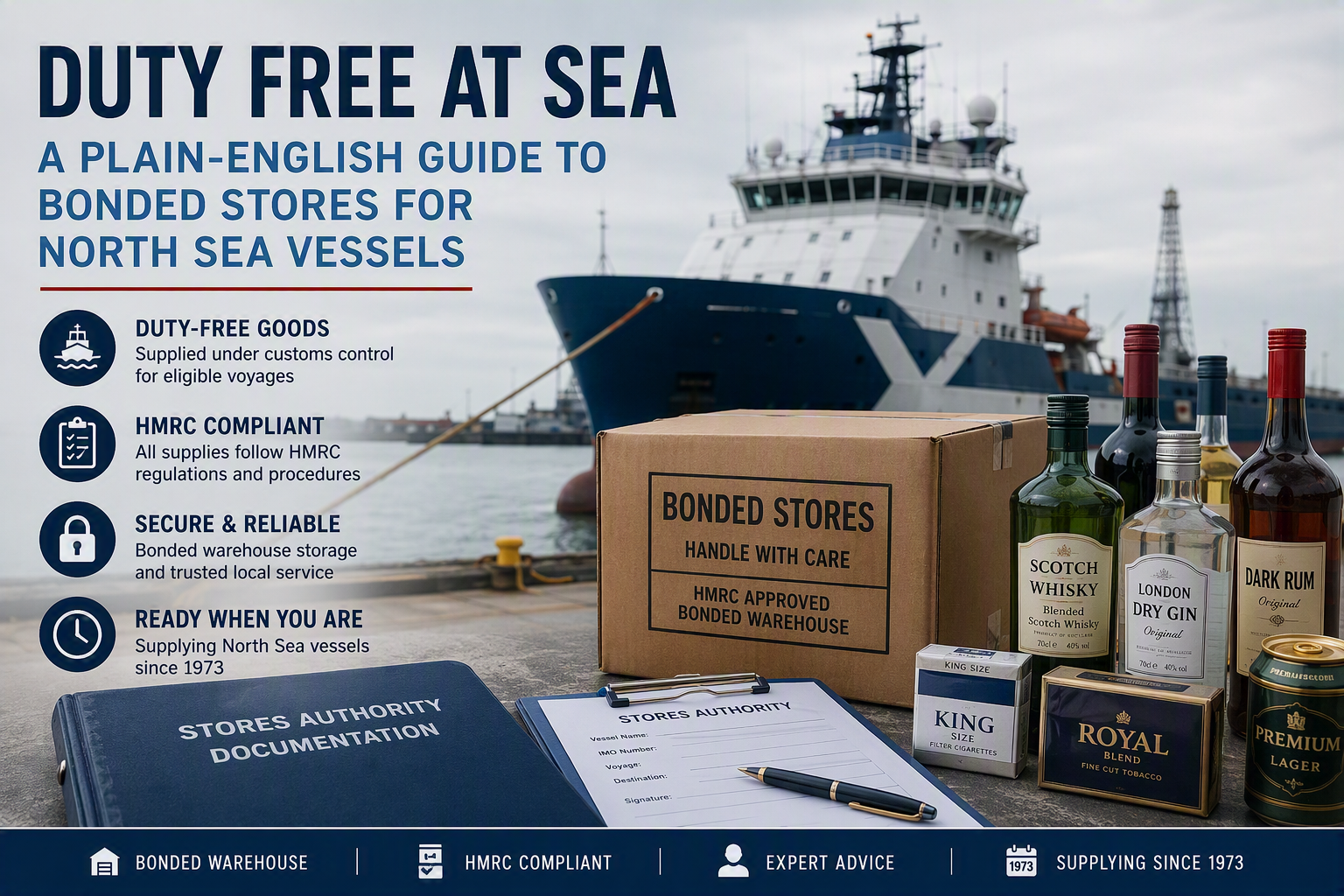
What are bonded stores, and how does duty free at sea work? This guide explains bonded stores for North Sea vessels, including duty-free goods, documentation requirements, HMRC rules and common mistakes
In simple terms, bonded stores are duty-free goods supplied to eligible vessels for use or consumption during a voyage. They typically include tobacco, vaping products and, where the operator permits, alcohol. These are exempt from UK duty because they are supplied under HMRC control for qualifying voyages.
If you are new to vessel operations, offshore logistics or procurement, the terminology can sound more complicated than it needs to be. This guide explains bonded stores in plain English and answers the questions most commonly asked by masters, pursers, vessel agents and operators working in the North Sea.
What Are Bonded Stores?
Bonded stores are goods held under HMRC control in a bonded warehouse, with duty suspended, before being supplied to an eligible vessel without UK duty being paid.
The key point is that these goods remain under customs control until they are legally supplied to a qualifying vessel.
This is why bonded stores cannot simply be sold or distributed in the same way as ordinary retail goods.
Why Are They Called “Bonded” Stores?
The term comes from the bonded warehouse system.
A bonded warehouse is a secure facility approved by HMRC where goods can be stored without duty being paid immediately.
Duty only becomes payable when goods enter the UK domestic market. If the goods are supplied under an approved customs procedure to a qualifying vessel, that duty liability may never arise.
The terms ship’s stores and bonded stores are often used interchangeably, but they are not always identical.
Ship’s stores can refer broadly to goods intended for use aboard a vessel.
Bonded stores refer specifically to goods supplied under customs control, usually with duty relief or excise treatment attached.
From a customs perspective, though, the distinction can matter.
United Supplies has operated bonded warehouse facilities in Aberdeen for decades and operates the only multi-user HMRC-approved bonded warehouse in Aberdeen.
United Supplies also worked with HMRC to secure duty-free access for the offshore industry in the first place.
That local presence matters when vessels require stores at short notice.
Which North Sea Vessels Can Receive Bonded Stores?
This is probably the most common question we receive.
The answer is: not every vessel qualifies.
Eligibility depends on factors including:
- Vessel type
- Voyage pattern
- Customs status
- Destination
- Operational activity
Examples of vessels that may qualify under the appropriate circumstances include:
- Offshore installations (rigs and platforms)
- Offshore supply vessels (OSVs)
- Platform supply vessels (PSVs)
- Construction support vessels
- Survey vessels
- Research vessels
- Accommodation vessels
- Fishing vessels
- Certain offshore wind support vessels
- Vessels engaged in international voyages
The exact circumstances matter, which is why documentation should always be checked before stores are supplied.
A vessel working entirely within UK territorial limits may be treated differently from a vessel operating internationally or servicing offshore installations.
What Types of Goods Are Usually Supplied as Bonded Stores?
The most common requests involve:
Tobacco and Vaping Products
Including:
- Cigarettes
- Hand-rolling tobacco
- Cigars
- Vapes and e-liquids
- Heated tobacco
Alcohol (where permitted)
Including:
- Whisky
- Vodka
- Gin
- Rum
- Wine
- Beer
Other Duty-Free Supplies
Alongside bonded stores, we also supply nicotine pouches, confectionery, soft drinks, electronics, and fragrance and cosmetics from leading brands. These are not held under bond, but can still be supplied to qualifying vessels as ship’s stores.
The availability of products and eligibility rules should always be confirmed before delivery.
HMRC Rules and Documentation
Bonded stores are heavily regulated.
Bonded supplies operate within a framework set by HMRC, with documented procedures at every stage.
The main HMRC guidance is Excise Notice 69a, which covers loading excise goods as ship’s stores. Alcohol and tobacco stores also need a stores authority on HMRC form C945.
The paperwork is not simply administrative. It creates the audit trail that allows duty-free goods to move legally through the supply chain.
Requirements vary according to vessel type and voyage.
Typically, suppliers may need information such as:
- Vessel name
- IMO number
- Voyage details
- Destination information
- Stores authority (HMRC form C945) for alcohol and tobacco
- Master or authorised signatory details
- Quantity requested
The guiding principle is straightforward:
HMRC expects suppliers to be able to demonstrate why duty-free treatment was appropriate.
Without adequate documentation, stores generally cannot be released.
The stores authority must be signed by the ship’s master or someone authorised to act for them. Check this before the paperwork is sent, as an unauthorised signature is one of the most common causes of delay.
External Reference:
- HMRC Customs Warehousing Guidance: https://www.gov.uk/guidance/customs-warehouses
- GOV.UK Customs and Excise Guidance: https://www.gov.uk/government/organisations/hm-revenue-customs
How Are Bonded Stores Delivered?
For Aberdeen operators, we deliver bonded stores directly to the quayside before sailing, using our own delivery fleet.
Timing can be critical.
A vessel may have only a narrow mobilisation window before departure, particularly during busy periods in the North Sea energy sector.
Deliveries are typically coordinated with:
- Port agents
- Vessel operators
- Masters
- Offshore logistics teams
The objective is always to ensure stores arrive in time for departure while maintaining complete customs compliance.
What Mistakes Cause the Most Delays?
After more than five decades supplying vessels in Aberdeen, one issue appears more often than almost any other.
The vessel qualifies, the products are available and the delivery slot is booked, but somebody has left the paperwork until the last minute
Bonded stores are one of those things that seem straightforward when everything is in place and suddenly become complicated when documentation is incomplete an hour before sailing.
The safest approach is to confirm:
- Eligibility
- Documentation
- Quantities
- Delivery arrangements
as early as possible.
That simple step avoids a surprising number of problems.
Why Aberdeen Still Matters
Aberdeen continues to play a central role in offshore operations across the North Sea.
The region supports:
- Oil and gas operations
- Offshore wind projects
- Survey activity
- Construction campaigns
- Marine support services
Many vessels operating from Aberdeen require dependable access to bonded stores alongside other marine supplies.
A local bonded warehouse allows stores to be supplied efficiently and in compliance with HMRC requirements without the delays that can come from sourcing products further afield.
Vessels have changed and the offshore sector has evolved, with offshore wind now an increasingly important part of it. The practical requirement, however, remains the same.
Qualifying vessels still need access to duty-free supplies, and operators still need those supplies delivered correctly, legally and on time.
Bonded stores remain an everyday part of maritime operations throughout the North Sea.
Where Can You Get Advice on Bonded Stores in Aberdeen?
If you’re unsure whether a vessel qualifies, what documentation is required or how bonded stores can be supplied for an upcoming sailing, it is worth discussing the details before a delivery is arranged.
United Supplies is the only company in Aberdeen operating a multi-user HMRC-approved bonded warehouse.
If you’re planning a vessel mobilisation and need advice on bonded stores, give our team a call and we’ll talk through the requirements before sailing.
Related Reading:
- The Complete Guide to Duty-Free Supply in the North Sea (2027 Edition)
- Can Offshore Wind Vessels Take Duty-Free Stores? What Operators Need to Know
- Hydrogen, CCS and Marine Energy: The Next Duty-Free Frontier in the North Sea
- Supplying the ScotWind Build-Out: What the Next Five Years Look Like from the Quayside